

Lost & Found Losing & Finding Yourself In Your Art- Nancy Hillis MD
Lost & Found: Losing & Finding Yourself In Your Art
Since age 17, I’ve been thinking about the journey we’re on in this life.
Bored with classes my senior year of high school, I’d mostly stay home and read works such as Jane Eyre, Childhood’s End, Beowulf, Hamlet, The Canterbury Tales, The Odyssey and others. I’d finally arrive for my final sixth period class, Physics, the only class I looked forward to and felt challenged by.
But one book I read stood out in bas relief above the rest: Dante Alighieri’s (1265 – 1321) The Divine Comedy. In particular, the first book: Inferno.
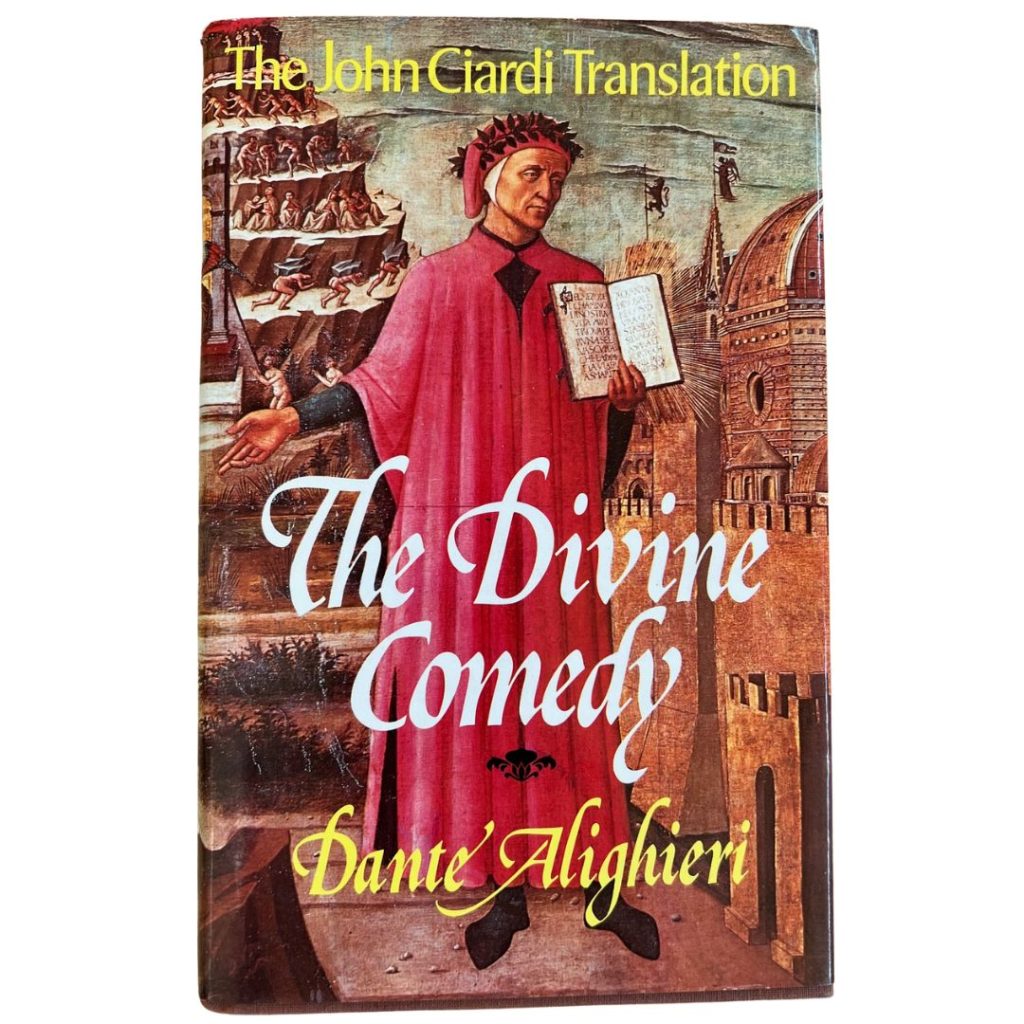
The Divine Comedy– Dante Alighieri. One of my favorite books. The painting on the cover is Dante and His Poem by Domenica de Michelino.
A Profound Book At A Pivotal Moment
Why was this book pivotal for me?
Dante spoke to me in his writings across seven centuries.
Dante’s Inferno, one of the greatest works of literature the world has ever known yet sadly not often taught in schools is about Dante’s journey of meaning, aliveness and love. You could say it was his search for divine love, for God.
Joseph Campbell would call it a hero’s journey.
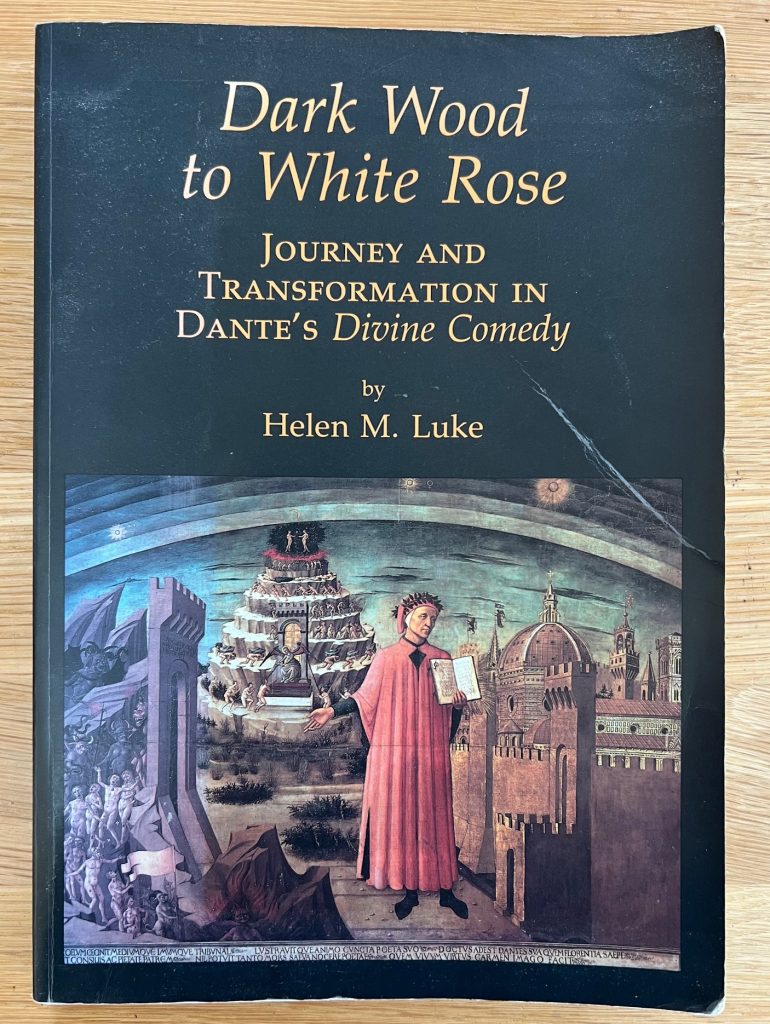
Dark Wood to White Rose by Helen M. Luke is a lovely book that discusses the transformation in The Divine Comedy. I
A Journey of Meaning
And just as Dante embarked on his perilous journey to find his way to love and meaning, as artists, we too are on our own journey of meaning, aliveness and transformation.
Indeed, we’re on our own Journey of Self-Expression.
One of the questions I’m intrigued with is how do you express your deepest work as an artist? How do you express you in your art?
I was trained in psychiatry in general and child and adolescent psychiatry in particular (and put my toe in the water of infant psychiatry…yes, there’s a field of study that explores psychology’s most elegant work: attachment theory) and I’m well acquainted with the seminal work of the late British child psychiatrist D.W. Winnicott.
Lost & Found
A brilliant clinician and theoretician, Winnicott found that as children we’re continually discovering the world and in that exploration, we get lost and then re-find ourselves over and over again.
Remember the game of “peek a boo”?
This is about being “lost” and “found” again. As adults, and in particular as artists, we’re doing that too.
We’re continually losing and finding ourselves in our paintings as we explore and experiment.
There’s a playful dance of getting lost in the moment and in the flow and then coming back to find our work with fresh eyes.
Lost & Found In Art
In art, we’re continually losing and finding our way as we search. There’s a dance, a push-pull as Hans Hoffman would say, as we can explore with lost and found lines and shapes.
Michelangelo explored lost and found edges in his sculptures, particularly his non-finito” (incomplete) sculptures, which reside in the Galleria dell’Accademia de Firenze (the Accademia Gallery) in Florence, Italy.
When I was 33, I traveled to Italy with my parents. My mother and I wept when we saw Michelangelo’s unfinished sculpture of Mary holding up her dying son, a mother’s anguish, and I thought of the shortest line in the Bible. Jesus wept. He was 33.
Twenty-five years later, Stanford Medical Alumni offered a trip: Art & Anatomy in Florence and I leapt at the opportunity when it said we would have a private viewing of the Accademia. I yearned to see the unfinished sculptures without the crowds.
We sketched David and marveled at Michelangelo’s artistry as well as the scale of the sculpture, especially David’s hands.
But the part I cherished most was sharing this experience of viewing the unfinished sculptures with my then seventeen-year-old daughter, just as my mother had with me so many years before.
When it came time to leave, I lingered. Wistful and realizing I might never see these works again, Our group had already left. I stood there alone.
The guard, with a heavy ring of keys like something you’d see in an old movie, approached—not to hurry me along, but to join me in a sense of wonder. He smiled and pointed to Atlas and said something in Italian, gesticulating wildly and I “answered” back with my own gestures of appreciation and awe.
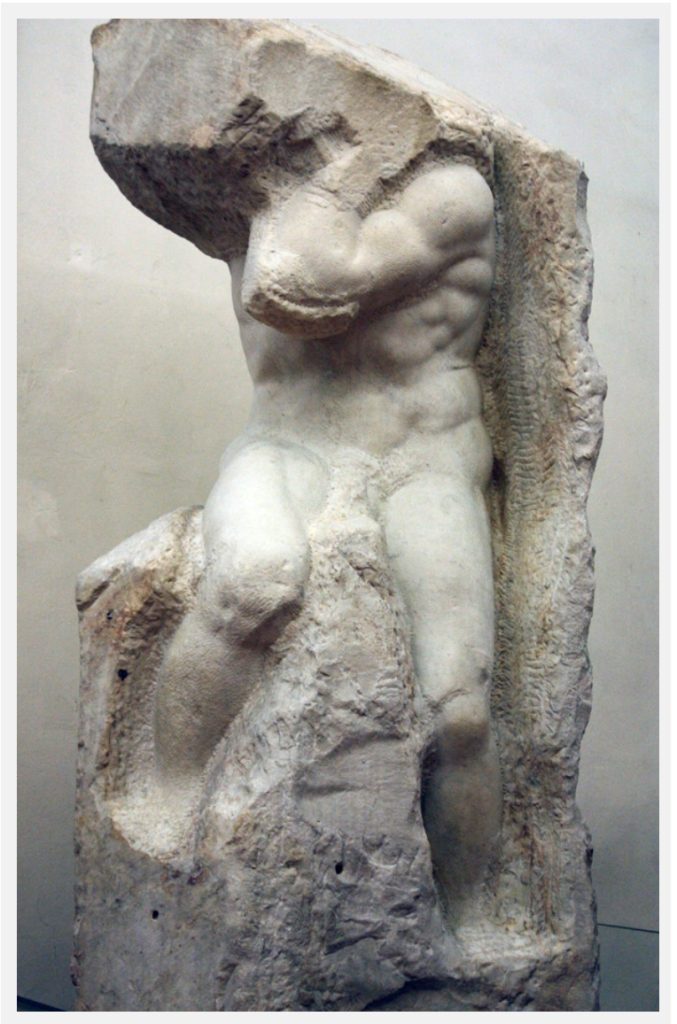
The Atlas, Michelangelo (1530 – 34)
Games Of Lost & Found In Childhood
Even in the games of childhood, particularly babyhood, we’re losing and finding ourselves and others and this is a profound developmental progression towards the development of a sense of self.
In Beyond the Pleasure Principle (1920), Freud described that his grandson, affected by the, separation from his mother, played with a spool. He tied the spool to a string and put it under his bed. He made it disappear, then reappear, by pulling on the string, and said, “Gone, and here it is again.”
It’s as if the child asserts, “No, you’re not going away, Mommy. This spool is you and I can make you go away and pull you back when I want to.” Grappling with separation anxiety, the child asserts control through the game.

Peek a boo
In the delightful game of peek-a-boo, the mother and child play with being lost and found. There are countless variations. In one iteration, the mother hides behind her hands and asks “Where’s mommy?”
Tension builds as the baby gets anxious (Where’s mommy? She disappeared!) The mother gauges the tension and then uncovers her face to the delight and bliss of the child. There she is again!
In another iteration, the baby hides herself behind her hands or a cloth and Mommy says, “Where’s baby? Oh my, where’s my baby?” Tension builds. Baby removes her hands or pulls the cloth away and laughs uproariously.
It’s through play that we work through the pain of separation and loss as children.
It’s been said that play is the work of childhood and I believe, as adults, it’s our work too.
Kohut & Artistic Enjoyment
As a side note, the eminent psychologist, Heinz Kohut, said that in this capsule just described is the whole theory of artistic enjoyment, opining, “There are endless ramifications in setting up tensions and then relieving them.”
Finally, we have the glorious game of “This Little Piggy”. Kohut said this is a game of self-cohesion and fragmentation. We start out “whole” and then the little piggies go off in various directions, setting up a feeling of “falling apart” . Excitement builds as the child is “taken apart” and then the final piggy says, “Wee wee wee, all the way home” and the mother embraces the child as she is “put back together again”.
Themes of fragmentation and restoration, loss and reunion, losing and finding ourselves, have poignant implications for our lives and our art.
If you enjoy this discussion connecting childhood games to existential issues of connection and loss, you might like my talk to the San Francisco Opera Guild on these topics and how they connect to Art and the Hero’s/Heroine’s Journey as creators.
Why It’s Important To Express Yourself In Your Art
So this begs the question of why it’s important to express yourself in your art.
I think at a deep level it’s about connecting authentically with your true self.
It’s about finally coming home to yourself.
It’s about trusting yourself.
You could say it’s ultimately about re-finding yourself, just like Dorothy in The Wizard of Oz, when she realized that her journey was a dream and that the answer to her searching was inside herself the whole time.
The Question
So I ask you:
What truth lives inside you that your heart is burning to express?
Much love from my studio to yours,
Nancy
P.S. If you loved this post, you’ll love our book: The Adjacent Possible.
Here’ s a book reading from Chapter One of The Adjacent Possible: Evolve Your Art, From Blank Canvas To Prolific Artist
The Adjacent Possible Book Reading
Book Reading: The Adjacent Possible: Evolve Your Art. From Blank Canvas To Prolific Artist
The Adjacent Possible book is about the art and science of the possible- evolving your art, cultivating your fullest self-expression and getting to the elusive deepest work your heart yearns to create.
You have a dream but you don’t know how to bring it to life. It has lain fallow for years, like a dormant seed, sleepy in the cold earth, waiting for sustenance. waiting for you to bring it alive.
Learn the science of creativity, the adjacent possible
- guide you to evolve your art
-
nudge you to create art that excites, scares and wows you
-
inspire you to move past emulating not only others, but yourself in your art
Becoming a great artist is about the movement of coming closer to who you are and reaching the fullest expression of YOU in your art.
Winner of International Reader’s Favorite Gold Medal & Book Excellence Awards

The Adjacent Possible- Awards
The Adjacent Possible Book Trailer
Kindle Readers Highlights

The Adjacent Possible Highlighted by Kindle Readers
Book Quotes

The Adjacent Possible quotes in book
Exploring The Adjacent Possible

Exploring The Adjacent Possible
Bestseller
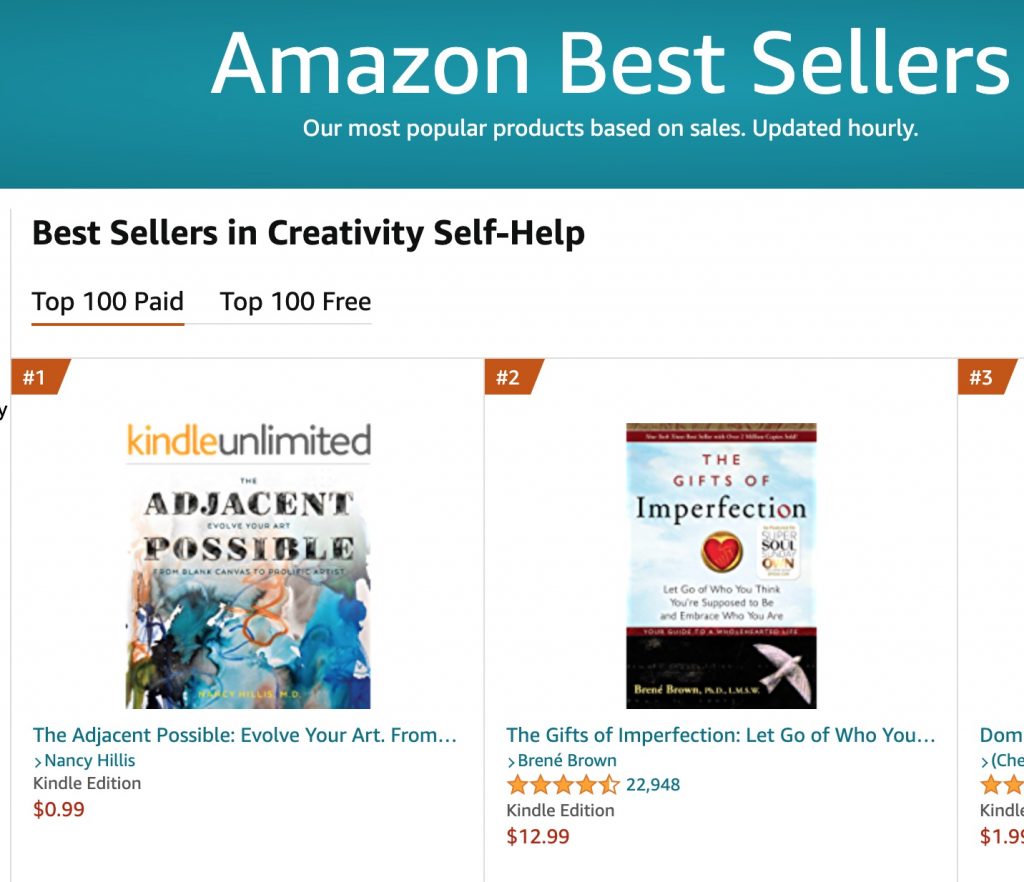
#1 Best Seller: Creativity Self-Help- The Adjacent Possible
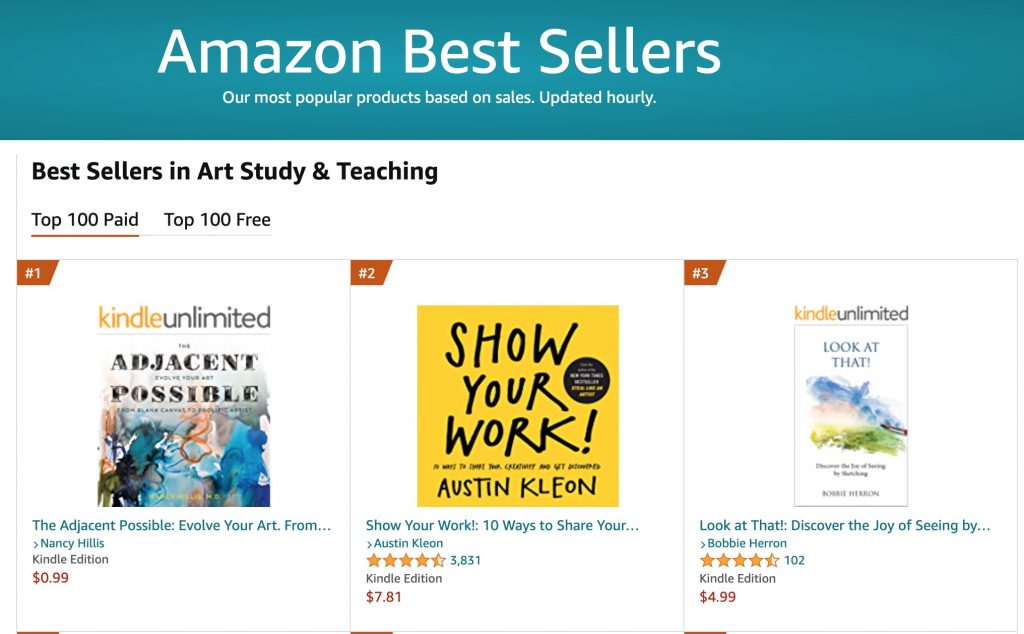
The Adjacent Possible Best Seller Art Study & Teaching
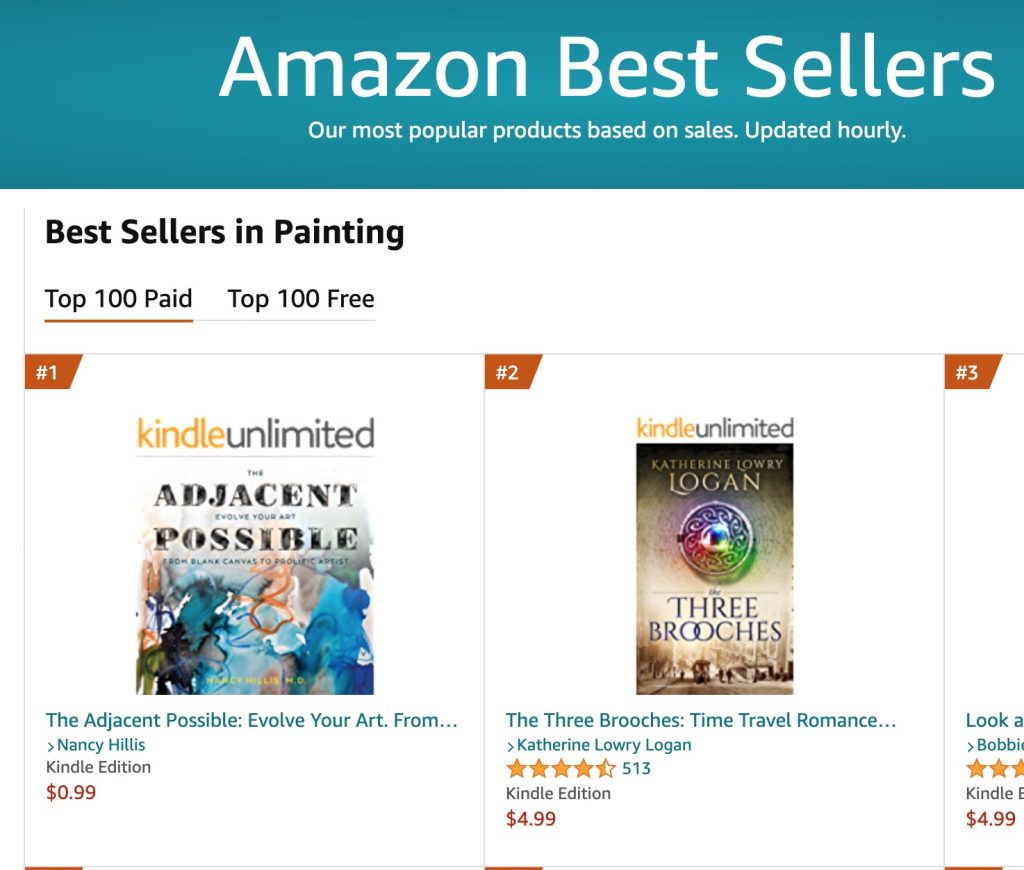
The Adjacent Possible- #1 Best Seller in Painting

Sound compelling? If you enjoyed the reading, you’ll love the book.
Get your copy HERE.
P.S. Get the ebook HERE and register for the free 5 Day Creativity program when you purchase the book.




If you have an itch to paint freely that won’t be scratched then try Nancy’s courses and her books the freedom to play is delicious in any medium and on any surface!! Memories of chalking on pavements and walls as a child with such great excitement and risk!!! Delicious!!!
Great story and perfectly possible as witnessed by one who did your courses. The blog makes the apparent impossible POSSIBLE and ACTUAL. The only requirement is the sheer need to paint!!! This is what Your books open a wide door to achieving that impossible possible. Thank you.